Mustard (Sinapis arvensis)
Mustard, the remedy for those who feel depressed for no apparent reason, is made by the boiling method.
Sinapis arvensis (wild mustard or charlock) is often considered to be a weed, growing alongside commercial rapeseed (Brassica napus) crops. Both are part of the mustard family and contain significant quantities of erucic acid. This is an omega-9 fatty acid and tests on animals in the 1970s suggested a possible link with the development of heart disease. As a result, low erucic acid rapeseed (LEAR) or canola was developed. Although there is no evidence of health problems in humans from dietary ingestion of eruric acid, only up to 5 % erucic acid content is permitted within the EU.
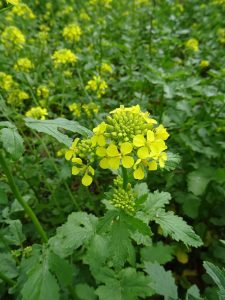
Charlock; image from pixabay.com
Lorenzo’s oil is a combination of triglycerol forms of oleic acid and erucic acid from olive oil and rapeseed oil, respectively. The use of this oil as a treatment for adrenoleucodystrophy (ALD) was popularised by Augusto Odone. His son, Lorenzo, suffered from the condition, which causes a build-up of very long chain fatty acids in the blood. This leads to brain damage and usually causes death within two years.
A fictionalised version of the story was made into a Hollywood film in 1992 and the oil was shown as a miracle cure. However, although it did slow down progression of the disease, the oil was not a cure and patients did eventually die. Lorenzo died in 2008, aged 30, 24 years after being diagnosed with ALD and given 2 years to live. Although not a cure for patients showing symptoms of ALD, the oil has been shown to delay the disease being developed by people who have the ALD gene.
Charlock has been used as a human and animal food source. The leaves can be eaten raw in salads when young or cooked when older. The seeds can be sprouted and eaten raw to give a hot flavour or ground into a powder and used as a mustard-like food flavouring. They also produce an edible oil which burns well.

Chemical diagram of sinalbin
Charlock contains the toxic compound sinalbin which was first found in the seeds of white mustard (Sinapis alba). Silanbin reacts with an enzyme myrosinase, also found in the plant, to give 4-hydroxybenzyl isothiocyanate, sometimes known as mustard oil. This highly unstable and pungent compound degrades quickly (half-life in the stomach is 1-2 hours) to produce gastrodigenin, an almost odourless 4-hydroxybenzyl alcohol and the isothiocyanate ion, which is poisonous. White mustard seeds are sometimes used to make the condiment known as mustard, but the flavour is much less pungent than that obtained using black mustard seeds (Brassica nigra).
Dried seeds of white mustard have rubefacient properties and were sometimes used to treat digestive disorders and as a laxative, particularly for older people. However, there is a danger that seeds remain in the intestines where they cause inflammation of the stomach and intestinal canal. An infusion of the seeds was used to treat rheumatism and bronchitis and a gargle of mustard seed tea was sometimes used to ease a sore throat.
The pungency of black mustard seeds is mainly due to another compound, sinigrin, which is also present in Brussels sprouts and cabbage but not in charlock or white mustard seeds. Sinigrin reacts with myrosinase to form an oil of mustard which degrades to produce compounds including the highly pungent allyl isothiocyanate.
Compounds produced by the action of myrosinase on sinalbin or sinigrin cause damage to the plant so are present in a safe form. They only react when the plant is under attack – myrosinase is kept in a separate compartment which only comes into contact with the sinalbin or sinigrin when the cell walls between them are damaged by cutting or chewing (or if the seeds or leaves are crushed).
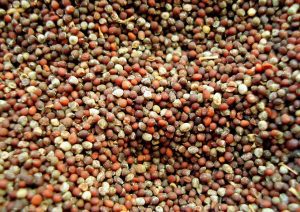
Mustard seeds; image from pixabay.com
A condiment made from mustard was used by the Ancient Greeks and Romans. In the Middle Ages, French monks generated income by selling mustard and Pope John XXII of Avignon (1249 –1334) loved mustard so much that he created the post of “Grand Moutardier du Pape” (Grand Mustard-Maker to the Pope). He gave the job to his nephew who lived near Dijon and this town soon became the mustard making capital of the world.
To prepare mustard, the seeds are crushed, the hulls and bran removed. The remaining powder is mixed with liquids such as vinegar or wine and salt and other spices or flavourings added.
For an introduction and sources and more info., click the links.