Holly (Ilex aquifolium):
Holly, the remedy for anger, jealousy and envy, is made by the boiling method.
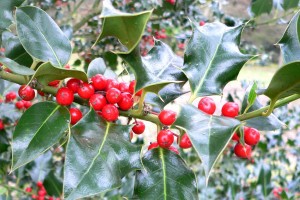
Holly; image courtesy Mo Sibbons
The species name aquifolium means pointed leaf and most of this evergreen shrub’s leaves are spiny to deter grazers. The red berries are an important food source for birds during the winter, when repeated freezing softens the berries and makes them taste milder. They are, however, toxic to humans.
Traditionally, holly was thought to offer protection from witches and sorcery. Some farmers used to allow holly to grow taller within a hedge to prevent witches running along it. Their reluctance to cut back the holly may also have had something to do with the belief that it was unlucky to cut holly except at Christmas.
Holly bark was stripped, boiled, fermented and pounded to make birdlime. This was a natural glue which was spread on the twigs of trees, trapping birds for food. It could also be used as an insecticide.

Tunbridge ware pin wheel c1870; Copyright © 2016 Amherst Antiques. All Rights Reserved.
Holly wood is white, hard and dense and was sometimes dyed to resemble more expensive woods such as ebony. It was also used for tool-handles and bobbins and, in Victorian times, in Tunbridge Ware objects. These were typically boxes made using a tessellated mosaic technique developed in Tonbridge and Tunbridge Wells in Kent. Holly wood was sometimes used to make white chess pieces. European settlers arriving in North America misidentified the unrelated native toyon tree as holly, and named the area of Los Angeles where it was abundant Hollywood.
Medicinally, the leaves were used to treat jaundice, fevers, rheumatism, smallpox and as a diaphoretic (to induce sweating) and tranquiliser. The berries were used as a powerful emetic. Herbalist Nicholas Culpeper recommended fresh berries as a purgative but dried, powdered berries were used to ‘bind the body’ and ‘stop fluxes’.
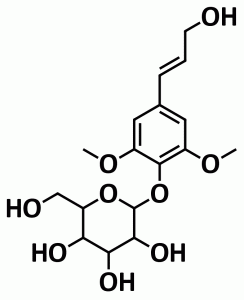
Chemical diagram of ilexanthin
The plant contains ilicin (a bitter principle), ilexanthin, ilicic acid, theobromine, caffeine and caffeic acid. Ilexanthin, also known as syringin, was first isolated from the bark of lilac (Syringa vulgaris). It contains a glucose group attached to a sinapyl alcohol and, when taken orally, sinapyl alcohol, which has anti-inflammatory properties and is an antinociceptive (i.e. reduces sensitivity to pain), is formed. Ilicic acid is phytotoxic i.e. it is toxic to plants and may be present to deter competitors from growing nearby.
The alkaloid theobromine is also found in cocoa, tea and cola and is used to treat asthma. It is toxic to dogs in small quantities so renders chocolate poisonous to them. It’s also toxic to humans, but luckily, it’s not present in large enough amounts in chocolate to be problematic! Theobromine is one of the compounds credited with rendering holly berries toxic (along with caffeine and ilicin). It is estimated that a child can safely consume 1-2 berries but that 20 berries may be fatal.
For an introduction and sources and more info., click the links.