Beech (Fagus sylvatica):
Beech, the remedy for people who are over-critical and intolerant of others, is made by the boiling method.
Beech was considered a holy tree and prayers said under a beech were said to go straight to heaven. Swearing under a beech tree reputedly caused the tree to rustle in protest and if offence was severe a branch might fall off. Dried leaves were sometimes used to fill mattresses, but although soft and fragrant, sleeping on the mattress could be noisy as it would rustle, which earned beech mattresses the nickname “lits de parlement” or talking beds.
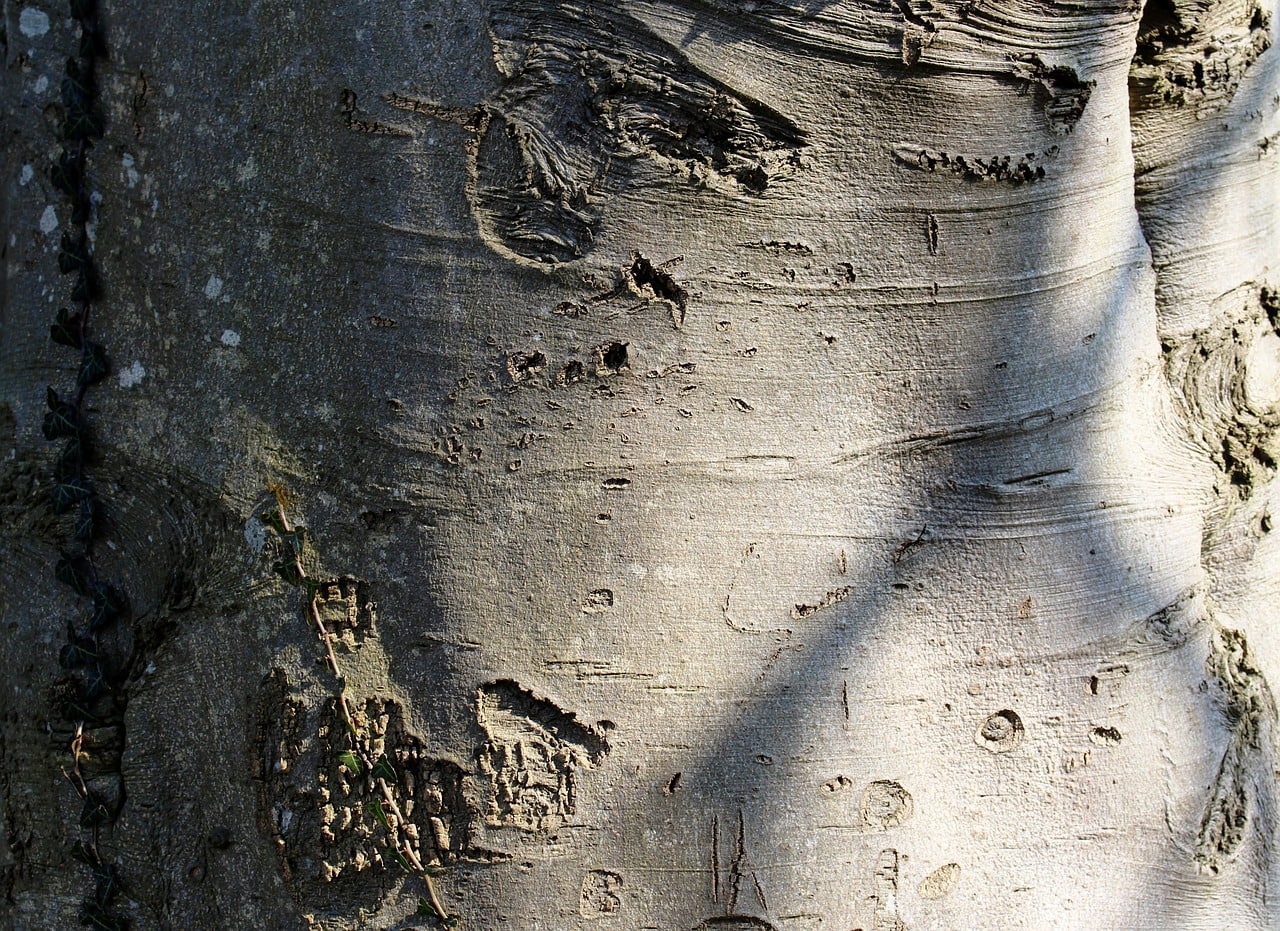
Bark of a beech tree; photo pixabay.com
Beech trees are the largest native trees in the UK, reaching over 100 feet. The silver-grey bark is soft and doesn’t heal on cutting so is popular when people want to carve their initials on a tree. This property may be related to the origin of the word ‘book’, from the Proto-Germanic bokiz (for beech). An alternative suggestion is that ancient runes were inscribed on beech tablets. Other uses of the wood include to make furniture, wooden spoons and rolling pins. The US lager Budweiser is aged over beech wood chips for 21 days, however, as these are boiled with bicarbonate of soda before use, they have no effect on the taste. Beech wood is burned to produce soot which is then boiled and diluted with water to produce the dark grey-brown pigment bistre, used by some of the Old Masters.

Beech leaves in autumn; photo pixabay.com
Beech foliage is dense, stopping around 80% of sunlight reaching the ground, meaning beech woods provide an important habitat for shade-loving plants such as box (Buxus sempervirens). Beech can be used in hedging and, if clipped, doesn’t shed its leaves. Leaves were traditionally used in a poultice to relieve swelling.
Beech nuts (or masts) are edible, although their high tannin content makes them mildly toxic in large quantities. The genus name, Fagus, comes from a Greek word meaning to eat, referring to the edible nature of the nuts. In France, nuts are sometimes roasted and used as a coffee substitute. Wood was traditionally used to smoke herring and the Beech-Nut food company originated in 1891 to sell beech-nut ham which was smoked to a traditional recipe. In UK, the company was best known for the Beech-Nut chewing gum, available from 1910. Nuts contain around 20% of a non-drying oil which can be extracted and used for cooking.
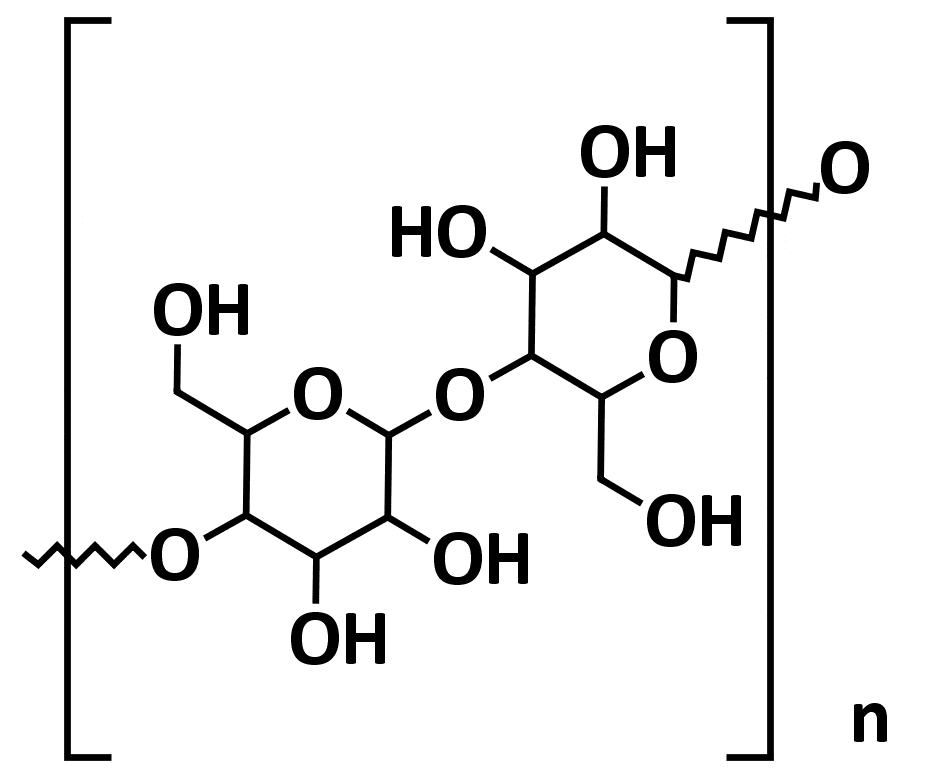
Chemical diagram of cellulose
Cellulose is a polysaccharide (a large molecule made from glucose units), found in plant cell walls and fibres. Cellulose from beech wood pulp is processed to form modal, a soft fibre used in clothing and household goods. The process involves steps to chemically alter then regenerate the cellulose to purify it and change its properties. Although the raw material comes from a natural source, the extensive processing results in modal being considered a semi-synthetic fibre.
For an introduction or sources and more info. click links.