Chicory (Cichorium intybus):
Chicory, the remedy for possessiveness, is prepared by the sun method.
It is also known as succory, monk’s beard or barbe de capucin in France. Chicory was used in salads, as a vegetable and as a medicinal plant by the Egyptians, Greeks and Romans. In Germany, it is sometimes known as watcher-of-the-road, recalling the legend of a girl who waited in vain by the roadside for the return of her lover and, exhausted, sank and died on a patch of chicory.
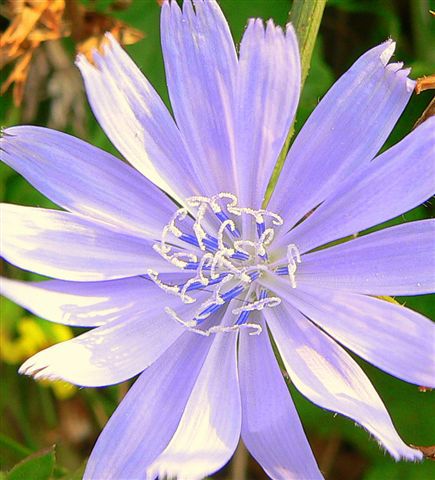
Chicory – photo by Mo Sibbons
Chicory root was roasted and ground for use as a coffee substitute in Napoleonic times, when coffee supplies were limited. It was believed to be a contra-stimulante, balancing the stimulating effects of coffee and particularly valued as a drink for bilious people. Medicinally, it was used as a tonic to increase flow of bile, to aid the liver and digestion, as a diuretic, to kill parasitic worms and for constipation. Flowers were used to make an eyewash to soothe inflammation. A blue dye can be made from the leaves.
Today, varieties are cultivated mainly for use of the leaves in salads (e.g. radicchio) or for the roots (Cichorium intybus var. sativum) for use as a coffee substitute or adulterant. Camp coffee, available since 1885, contains 26% chicory essence, along with water, sugar and de-caffeinated coffee essence. When mixed with coffee, chicory makes the drink more bitter and darker in colour.
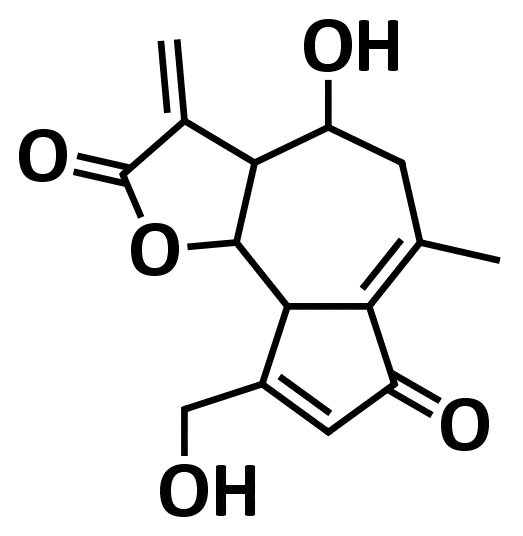
Chemical diagram of lactucin
The two major bitter principles in chicory are lactucin and lactucopicrin, which are also found in wild lettuce (Lactuca virosa). Both have demonstrable antimalarial activity as well as acting as analgesics and sedatives. In wild lettuce, they occur in the latex and are therefore components of so-called lactucarium (lettuce opium) which was used as a drug by the Ancient Egyptians. Lactucarium is occasionally used today as a legal high although its misuse can result in death.
For an introduction or sources and more info. click the links.
Next time: clematis
P.S. I haven’t forgotten chestnut bud..there are three remedies based on horse chestnuts and their entry will be ‘the horse chestnuts’!